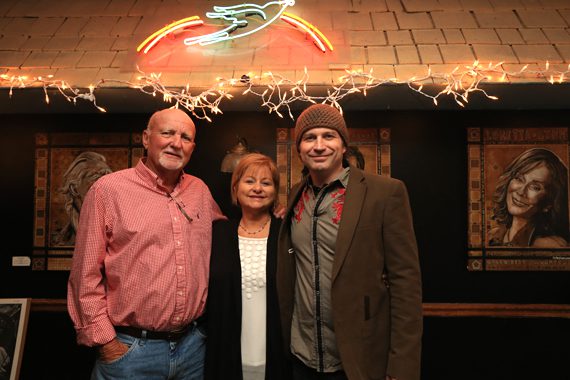
Bruce Hinton
Bruce Hinton might just be the happiest tourist in
Nashville this week. On Monday night (June 6), the former chairman of
MCA Nashville will be cheerfully mingling with past staffers and MCA
artists at an unofficial company reunion. The following night, he’ll be
celebrated as a founder of the City of Hope celebrity baseball
tournament, which is marking its 26th annual game this year.
Hinton came up with the idea for the game after touring the City of
Hope campus near Los Angeles in 1991. Although he had been making
personal donations to the medical research organization, the visit
convinced him to become even more involved. Today he’s quick to praise
City of Hope’s research findings as well as their efficiency as a
charitable organization.
After making a name for himself in the music industry in Los Angeles,
Hinton moved to Nashville in 1984 in the role of Senior Vice President
and General Manager of MCA Nashville. In 1989, he was named president
and then elevated to chairman in 1993. In 2002, Hinton stepped down to
become Chairman Emeritus. The track record during that era is still
impressive. During the 1990s, MCA Nashville was named Label of the
Decade by
Billboard and
R&R.
These days, the 79-year-old Hinton divides his time between summers
in Park City, Utah, and winters near Palm Springs, California. Yet he’s
quite happy to chat over the phone about his upcoming trip to Music
City.
 MusicRow: How did you create the City of Hope game in Nashville?
Hinton:
MusicRow: How did you create the City of Hope game in Nashville?
Hinton: I was looking at what we then called Fan
Fair, and I thought it was great that we had all the music. But there’s
this whole country music lifestyle that’s about family and being
outdoors and sports, and I thought, “What a great way to kick off Fan
Fair week if we had a celebrity softball game.” It totally fits anything
you’d want to think about, for the country lifestyle or the country
music lifestyle. I went up and down Music Row to all the label heads and
they said, “Oh sure, we’re on board.”
A little aside: I went to the general manager of the Nashville Sounds
stadium and told him what I wanted to do. I said, “You can have the
concessions and the parking, so it’s a good thing for the city and
you’re making a profit.” He was kind of a crusty character and he said,
“Well, I guess … but I’m telling you, you’ve got a loser.” I said, “What
do you mean?” He had had some “names” come in and perform and he said,
“I’ve tried that stuff and it just doesn’t work.”
This was back in the day and the baseball teams were WSM and WSIX,
the No. 1 and No. 2 country radio stations in town. For ratings, they
were so competitive. And I said, “You just watch, people will be here.”
The first year, they totally ran out of concessions about halfway
through! They didn’t have one Coke or one hot dog or anything left. So, I
think I made my point.
Was it an easy sell for artists to get involved?
Yes, it really was. Speaking of that, who better for me to acknowledge than
Vince Gill?
There’s been 25 games and I want to say he’s been there for maybe 23 of
them. One year I understand the President of the United States wanted
to have a game of golf with him. (laughs) Priorities, priorities, what
can I say?
And just over the weekend, Trisha Yearwood got back to me and she’s
going to sing the national anthem. She’s one of the first people to show
up and participate. Actually every superstar in the first couple of
years were all there, and for many years forward. And I look at who’s
been there recently, like
Florida Georgia Line. I think it’s great that the new, white-hot artists are participating also.

2015 City of Hope. Photo: Bev Moser
I know Trisha Yearwood was one of your artists when you were at MCA.
Oh, I remember very well going to Douglas Corner with
Tony Brown
and we saw her. There was a country band that was performing that she
was friends with. She worked up some of her songs with them and she just
blew me away. Trisha and I have been not only business friends, but I
think we’re personal friends. She’s very special.
I wanted to ask about that time in Nashville history. How would you describe the city in the 1990s?
The golden years. (laughs) We were label of the year for 10 years,
and the trades called us the label of the decade. It just doesn’t get
any better! You think about the artist roster that we had from Vince to
George Strait and Trisha and
Reba McEntire, on down the line. I look back on that and I can’t believe it. Even
George Jones was on our label in his later years and I loved working with he and Nancy. Those are really precious memories.
When I was researching your career, I saw that you served on a
lot of boards. That’s a big time commitment. Why was it important for
you to be involved in so many organizations?
Well, each one I thought made a major contribution to Nashville. To
give you an idea, when I served on the TPAC board, no one from the music
industry had ever served on that board before. I remember one guy who
shall remain nameless who owned a mega-corporation. On my first year on
the board, he pulled me aside and said, “Just tell me, why is it that
Music Row doesn’t want to participate in the community?” So, there’s
your answer. I felt like we needed to be represented and not just be
this enclave that’s never gone outside of Music Row.
In the 1980s and 1990s, before the internet was so prevalent,
I would imagine that being on those boards would have been a good way
to communicate and to know what everybody was doing.
Yeah, I think it was the best thing I could have ever done. We were
very successful as a label, but at the same time, “Downtown” as we
called it back then, was saying, “Hey, there really is something to this
Music Row.” Back then, downtown folks looked at us as the hayseeds up
there on Music Row. We didn’t get any respect! And that’s the bottom
line. What you don’t know, you don’t know, and I thought they’ve got to
get to know who we are and what we’re about. That was all part of it.

Owen Bradley
You moved to Nashville in 1984, right?
Yeah, that’s exactly right, and what a wonderful time to come in.
Owen Bradley
was still around. I put him way up on a pedestal and we had a great
affinity for each other. He came from big bands and I knew everything
there was to know about big bands as a high school kid. I knew every
chair [of the orchestras] of Duke Ellington and Woody Herman and Stan
Kenton and Count Basie. I knew every one of their names. He couldn’t
quite figure out where that came from! We just got along famously, and
of course, that was really neat that Owen and
Chet Atkins
were there. I thought so highly of those people. Anyone who starts
something, kudos to them. And they started something so special that’s
better than ever today.
When it comes to your legacy in the music business, how do you want to be remembered?
It’s a good question that I’ve never thought of an answer to, so I’m
ad libbing here, but… you know, I was in the music industry because I
was a total, total fan of the music. I figured out my junior year in
college that I was never good enough to make it as a musician. It’s a
long story short, but I thought, “You know, there’s a music business
too.” Remember, this was before there was such a thing as [studying the
music business at] Belmont. I thought, “Wait a minute, if I can find a
way to get into this record thing, I’ll be working with these people
that I admire so much.” That was really what it was about. I wanted to
be in the music business, making a difference.
On a side note that you can pull in, it’s also important to mention
that when I became president and chairman of the division, it was very
important to me about what kind of culture we had. We had a culture of
respect and caring and everyone pulling together for their best effort,
and they were recognized as such. I am very proud of that. I look at
that 10-year legacy, I’m just glad to say that I was there. Can you
imagine the focus it takes to do that over a 10-year period? And they
did it.